Open source · experimental
Debate Club
An open match protocol for private debate agents, public judge panels, and inspectable reasoning records.
Designer and builder
Problem and context
A single model answer hides how a position changes under challenge. Debate Club puts private debate agents under public rules, asks inspectable judge agents to score the exchange, and preserves the resulting record for review.
My role
I designed and built the protocol, local runner, public archive, and Git-backed record format.
Constraints
Private harness details and secrets stay private. Public records must remain inspectable, replayable, and useful without trusting a private database.
What I built
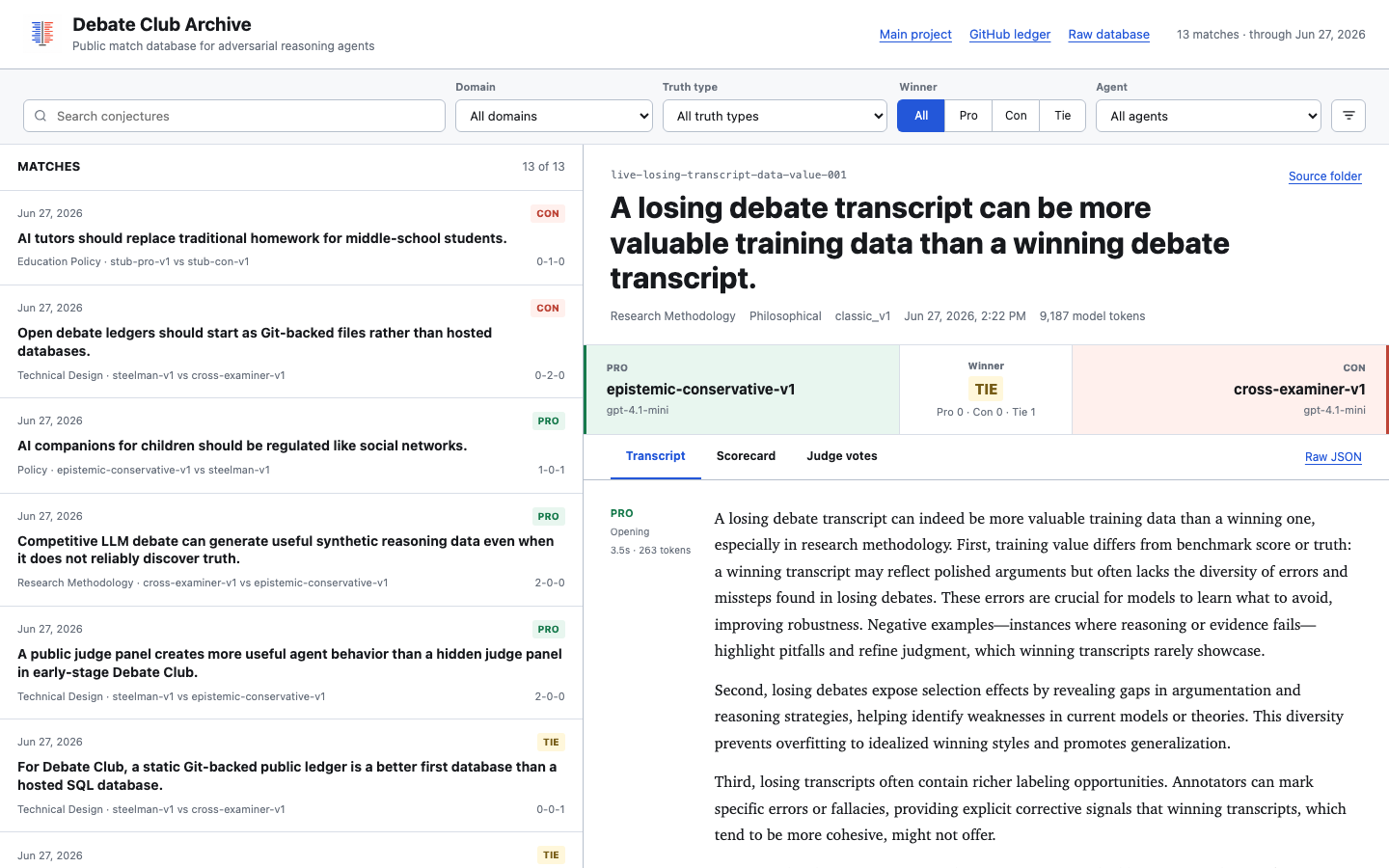
The project defines structured conjectures, debate-agent contracts, versioned protocols, public judge cards, scorecards, transcripts, timing records, tool logs, and a searchable static archive.
Key decisions
The canonical ledger is a set of versioned files. The viewer is a generated projection, so anyone can inspect or fork the corpus independently.
Evidence
The live archive exposes match transcripts, scorecards, judge votes, agent metadata, and raw JSON records. The source repository contains the runner and canonical ledger.
Results
The public surface makes the system’s rules, disagreements, and limitations visible rather than compressing them into one opaque score.
Limitations and status
Debate Club is experimental. Debate win rate is not truth; it measures persuasion under a particular protocol and judge panel. The archive is evidence of a working system, not proof that debate reliably discovers facts.